New Workflow Learning App?
The new google desktop search is very cool. It is fast. Talk about reducing slack. Now if we can be able to indicate all my different locations of files (laptop, Ipac, home PC) and have it search all at once, that would be great.
Any one else trying it?
Showing posts with label Training2004. Show all posts
Showing posts with label Training2004. Show all posts
October 19, 2004
October 14, 2004
Old Post for Training 2004
0
comments
tags:
Training2004
During the last session we took some time to kind of revisit our understanding of workflow learning and try to come up with an elevator pitch and some basic ideas. During that discussion we talked about where learning is aligned within the organization. Many executives and managers can look at you and say, "Hey, we met the delivery date and no one went to training." Good point, but even the executives know that it is a competitive world and if we don't get better as an organization we will die.
This led to the discussion of learning actually being part of the companies or organizations DNA. Pretty cool. It's just integrated into the "culture" of the organization. Great. OK, who's budget does it come out of? "Not mine. That's what HR is for." Right. But as we discussed yesterday HR is a support organization. They really aren't positioning themselves to align with organizational goals. While I'm sure some HR organizations are totally integrated into corporate strategy, they probably aren't working on a daily basis with engineers, or agents, or programmers, or whoever makes up the core competency of the organization.
OK and maybe someone can make a better argument then me for training being housed in HR, but that just doesn't seem to be right to me.
Really, we want training to support new business development (increase revenues) and increase productivity (lower costs).
To accomplish this we must be so integrated into the process and tasks of the organization that we understand what is being done, where the deficiencies are, and how we might be able to correct them. This reminds me of my earlier comments....
I think that workflow learning is being conceived on the premise that a dynamic solution (dynamic in that it can in some manner support itself and morph into a useful tool with as little human intervention as possible) that can be integrated into the work environment in such a way that the access to knowledge resources in whatever format needed is available to the employee (learner, performer, dude).
In my way of thinking, this seems very reasonable.
This led to the discussion of learning actually being part of the companies or organizations DNA. Pretty cool. It's just integrated into the "culture" of the organization. Great. OK, who's budget does it come out of? "Not mine. That's what HR is for." Right. But as we discussed yesterday HR is a support organization. They really aren't positioning themselves to align with organizational goals. While I'm sure some HR organizations are totally integrated into corporate strategy, they probably aren't working on a daily basis with engineers, or agents, or programmers, or whoever makes up the core competency of the organization.
OK and maybe someone can make a better argument then me for training being housed in HR, but that just doesn't seem to be right to me.
Really, we want training to support new business development (increase revenues) and increase productivity (lower costs).
To accomplish this we must be so integrated into the process and tasks of the organization that we understand what is being done, where the deficiencies are, and how we might be able to correct them. This reminds me of my earlier comments....
I think that workflow learning is being conceived on the premise that a dynamic solution (dynamic in that it can in some manner support itself and morph into a useful tool with as little human intervention as possible) that can be integrated into the work environment in such a way that the access to knowledge resources in whatever format needed is available to the employee (learner, performer, dude).
In my way of thinking, this seems very reasonable.


October 13, 2004
0
comments
tags:
Training2004
It's half time. Go Mountaineers!
I will try to get my thoughts together and add a lot more to the blog and I may go back reorganize. Although David Wienburger said you can't write too good to blog... ahhh I won't have a problem.
The last two sessions were really good. I really got to have good discussions with people around me. I sat a table with Clark Quinn. A while known writer in the industry. He was really into the discussion, the others in the group were great as well.
I will try to get my thoughts together and add a lot more to the blog and I may go back reorganize. Although David Wienburger said you can't write too good to blog... ahhh I won't have a problem.
The last two sessions were really good. I really got to have good discussions with people around me. I sat a table with Clark Quinn. A while known writer in the industry. He was really into the discussion, the others in the group were great as well.
0
comments
tags:
Training2004
Lunch Time Networking
I just finished lunch and found that the networking was quite interesting. Yesterday, I randomly sat a table with WebCT administrators for Marshall University (a college in West Virginia), then slid over and introduced myself to Jay Cross who has led the workflow sessions here at the conference. Today I sat with a couple of gentleman with experience in developing CBT for aircrafts, one of which was a pilot for an aircraft that I am currently developing training for. I wanted to pull the storyboard out of my bag and have him look over it.
Pretty wild.
I just finished lunch and found that the networking was quite interesting. Yesterday, I randomly sat a table with WebCT administrators for Marshall University (a college in West Virginia), then slid over and introduced myself to Jay Cross who has led the workflow sessions here at the conference. Today I sat with a couple of gentleman with experience in developing CBT for aircrafts, one of which was a pilot for an aircraft that I am currently developing training for. I wanted to pull the storyboard out of my bag and have him look over it.
Pretty wild.
0
comments
tags:
Training2004
Signs of Life
Someone responded to my blog. Very cool. I took a cab into the conference this morning, my feet hurt too much to walk....
Last night I began to think through workflow learning and the impact that it might have on small business. A couple of issues came to mind.
1. Immature Processes
2. People with Multiple roles, and
3. lack of resources.
This may require the technology-based training solution to possibly provide a process. The other issue is that one individual in small business does every process, until there are enough resources for another person, then three, and so forth. However, I've also noticed that small business leadership, in order to save money will take-on the support roles (financial, administrative) and the new business development role in order to keep overhead costs down.
This would have implications of how the training is structured, when it would be delivered, and the amount of resources that could be put toward the implementation or support system. Although it would seem that a technology-based performance support tool for small business has some real possibilities... All of these issues are addressable.
An interesting thought.... now that courseware is a commodity, it will undoubtedly trickle down due to cost reductions to small businesses and I actually think that is a good thing.
This will be low cost, maybe not-so-effective training, instead of no training or government sponsored Small Business Development Centers who say at the first session, do you have a business plan? At the second session, Do you have a business plan?.... And so forth. At least it will be some training in the right direction.
What do you think?
Lee
Someone responded to my blog. Very cool. I took a cab into the conference this morning, my feet hurt too much to walk....
Last night I began to think through workflow learning and the impact that it might have on small business. A couple of issues came to mind.
1. Immature Processes
2. People with Multiple roles, and
3. lack of resources.
This may require the technology-based training solution to possibly provide a process. The other issue is that one individual in small business does every process, until there are enough resources for another person, then three, and so forth. However, I've also noticed that small business leadership, in order to save money will take-on the support roles (financial, administrative) and the new business development role in order to keep overhead costs down.
This would have implications of how the training is structured, when it would be delivered, and the amount of resources that could be put toward the implementation or support system. Although it would seem that a technology-based performance support tool for small business has some real possibilities... All of these issues are addressable.
An interesting thought.... now that courseware is a commodity, it will undoubtedly trickle down due to cost reductions to small businesses and I actually think that is a good thing.
This will be low cost, maybe not-so-effective training, instead of no training or government sponsored Small Business Development Centers who say at the first session, do you have a business plan? At the second session, Do you have a business plan?.... And so forth. At least it will be some training in the right direction.
What do you think?
Lee
October 12, 2004
0
comments
tags:
Training2004
Blog Etiqutte
As I begin to type I am worried about blog etiquette . But I guess there is not a chapter on blogs in the APA. Interesting.... the word blog was not in the spellcheck sysem that I use for this???
I want to go back to some earlier sessions and revisit some of the ideas, but I worry that will throw off anyone following senquncially.... I guess my thought processes are complex, not sequencial.
As I begin to type I am worried about blog etiquette . But I guess there is not a chapter on blogs in the APA. Interesting.... the word blog was not in the spellcheck sysem that I use for this???
I want to go back to some earlier sessions and revisit some of the ideas, but I worry that will throw off anyone following senquncially.... I guess my thought processes are complex, not sequencial.
0
comments
tags:
Training2004
Evening
Another day in the books for Training Fall 2004. I thought that today was really interesting. As noted I participated in some really interesting sessions.
Does anyone know how to do a blogroll? Is that something that I can only get with a paid blogger service? I would like to put links to blogs that I read. That might be good.
I am pretty tired. Be engaed for 14 hours straight is pretty straining. I was on a call with a new client this morning (with people back east), ran to make the first session, and had a few calls in between sessions, and sat through vendor sessions during down time. I did take a minute to run over to Starbucks for a Jones Soda. (Starbucks seems to be a reoccuring theme in my life.)
Another day in the books for Training Fall 2004. I thought that today was really interesting. As noted I participated in some really interesting sessions.
Does anyone know how to do a blogroll? Is that something that I can only get with a paid blogger service? I would like to put links to blogs that I read. That might be good.
I am pretty tired. Be engaed for 14 hours straight is pretty straining. I was on a call with a new client this morning (with people back east), ran to make the first session, and had a few calls in between sessions, and sat through vendor sessions during down time. I did take a minute to run over to Starbucks for a Jones Soda. (Starbucks seems to be a reoccuring theme in my life.)
0
comments
tags:
Training2004
Afternoon
Lunch is done and I am back at the Cyber Cafe.... The Internet speed is awsome.
I am having a difficult time determining what session to go to next. I am leaning toward accelerated learning, but I'm just not sure.
Lunch is done and I am back at the Cyber Cafe.... The Internet speed is awsome.
I am having a difficult time determining what session to go to next. I am leaning toward accelerated learning, but I'm just not sure.
0
comments
tags:
Training2004
By the way... didn't go to the simulation.... I'll have to buy the audio to listen to it later.
0
comments
tags:
Training2004
Mid-day Tuesday.
I am at the conference and reflecting on my entries. This blog would probably be better if I did more reflecting and less sharing of my notes. I will try to adjust. The morning session on the information revolution was great.
THE INFORMATION REVOLUTION THAT WASN'T AND THE ONE THAT WILL BE
SPEAKER: David Weinberger, Author, Cluetrain Manifesto
He had many excellent points that really required me to reflect on the state of information sharing and human interaction. He discussed how we interact with information on the web and discussed blogs and wikis as two tools that in a way make that a better interface.
A couple of interesting comments... all students are collaborating on their school work, (cheating in the eyes of their teachers), meta data should not be explicit, and that social networks provide concepts in shades of gray. Knowledge is not an object to be placed in someone's head.
Pretty cool. We are currently working one a project that will try to facilitate this with both formal and informal content "weaved" around specific topics. Our term is "content tracks".
In my other session, we discussed how to weave the learning event around the workflow or tasks, so that they can directly improve performance....
So I take this to mean that I have to analyze our clients task or process, convince them to change it if it is not currently efficient of effective, then develop a learning object that can either teach or support that task, then put that into a tool that doesn't require the IT department to do anything.... and because we are in the government marketplace.... be the low-cost bidder. This all from an RFP that was for 6 courses in Recruiting.
Time to eat.....
If your reading, make some comments.
I am at the conference and reflecting on my entries. This blog would probably be better if I did more reflecting and less sharing of my notes. I will try to adjust. The morning session on the information revolution was great.
THE INFORMATION REVOLUTION THAT WASN'T AND THE ONE THAT WILL BE
SPEAKER: David Weinberger, Author, Cluetrain Manifesto
He had many excellent points that really required me to reflect on the state of information sharing and human interaction. He discussed how we interact with information on the web and discussed blogs and wikis as two tools that in a way make that a better interface.
A couple of interesting comments... all students are collaborating on their school work, (cheating in the eyes of their teachers), meta data should not be explicit, and that social networks provide concepts in shades of gray. Knowledge is not an object to be placed in someone's head.
Pretty cool. We are currently working one a project that will try to facilitate this with both formal and informal content "weaved" around specific topics. Our term is "content tracks".
In my other session, we discussed how to weave the learning event around the workflow or tasks, so that they can directly improve performance....
So I take this to mean that I have to analyze our clients task or process, convince them to change it if it is not currently efficient of effective, then develop a learning object that can either teach or support that task, then put that into a tool that doesn't require the IT department to do anything.... and because we are in the government marketplace.... be the low-cost bidder. This all from an RFP that was for 6 courses in Recruiting.
Time to eat.....
If your reading, make some comments.
0
comments
tags:
Training2004
Tuesday's Plan of Attack
8:30 The Information Revolution
9:45 Simulations, Games, and Pedgogy
11:00 USDA Awards (maybe)
2:30 training needs analysis
3:45 The art of Leadership
8:30 The Information Revolution
9:45 Simulations, Games, and Pedgogy
11:00 USDA Awards (maybe)
2:30 training needs analysis
3:45 The art of Leadership
0
comments
tags:
Training2004
Session 4 Workflow Learning Roadmap 2:00pm
This session started with Jay introducing Brad Cooper, who sat at my table in the morning. Brad discussed the current state of the LMS industry and how it might address the changes that are represented as the workflow learning initiated.
Key themes included the LMS does not focus on performance. The goals of the lms include:
- link people to work performed
- establish performance standards
- link performance issues to resources
-keep records of intervention
-associate resource to analysis
-provide mechanism for updating resources
-provide record keeping on resource updates.
Brad then presented a discussion on HRIS/ERP systems, Performance Management Systems, and Learning Management Systems.
More later....
0
comments
tags:
Training2004
Session 3, Nancy Lewis IBM 11:15am
This was a great session. Nancy was a very knowledgeable individual who was completely engaged in the creation a better process for her company and it came through in her presentation.
New strategy in learning.
On-Demand = leverages sophistication to do more...
Ebay = good example of redefining the business model
What are the implications for learning?
What learning is today?
- not enough time
- growing complexity
- new skill gaps
- difficulty finding what is needed
- increased spoof-to-market requirements
IBM intranet has 2.5 million searches per month
that's 45 man years a month searching for information.
Skill sets today are obsolete in 3-5 years.
We will always have consistent skill gaps.
IF YOU BELIEVE THIS>>>>
must approach learning in business different
80% learning happens in workplace 20% in traditional setting
So this would indicate the ISSUED is only addressing 20% of learning
Can we rachet up the effectiveness of learning at work? On-Demand Strategy
It is a fundamental change!
IBM innovates through practice.
reviewed with Stanford and Harvard and Sloan Foundation
Yes, we are all at the beginning.
The strategy. Three types of Learning.
Work Embedded - Work Enabled - Work Apart
All three build on strengths
Examples
- Things this sales person needs to do
bringing learning to work.
work activity in center. Personalized activities.
Task Specific - ability to connect to peers (experts)
methodology guide - communities for collaboration
"Best Practices" - accounting
Prescriptive learning -
1. Customer call - try to solve problem
IBM uses a learning agent to try to get a deeper understanding.
not only productivity- also ability to determine what goes up there, what are the new opportunities, other design solutions, higher or lower then industry, is this a problem, experts, dream up new innovation, integrate work teams and functional groups.
Have many of the groups that I work with, they haven't aligned to goals or work in functional groups....
I have about three more pages of notes that go into detail of the model.... I'll have to come back to them.
Nancy went on to provide a roadmap to implementation which was useful and explained each piece of the learning cluster.
It's kind of interesting, in the early 90's I has working on an Instructional Design Model called Cognitive Flexibility and while it wasn't performance driven in the sense of IBM's model, it has a very similar set of constructs in-terms of supporting the learning. We just developed it on stand-alone macs and video discs.
Nancy finished the session with the benefits and then engaged in a great discussion.
The Benefits
- focuses relevant learning resources to meet specific needs in the work context
- saves time. increase value for time.
- increases expertise and capability
- improves motivation and performance
- grows the business
That's got to be a slide the CEO sees.
This was a great session. Nancy was a very knowledgeable individual who was completely engaged in the creation a better process for her company and it came through in her presentation.
New strategy in learning.
On-Demand = leverages sophistication to do more...
Ebay = good example of redefining the business model
What are the implications for learning?
What learning is today?
- not enough time
- growing complexity
- new skill gaps
- difficulty finding what is needed
- increased spoof-to-market requirements
IBM intranet has 2.5 million searches per month
that's 45 man years a month searching for information.
Skill sets today are obsolete in 3-5 years.
We will always have consistent skill gaps.
IF YOU BELIEVE THIS>>>>
must approach learning in business different
80% learning happens in workplace 20% in traditional setting
So this would indicate the ISSUED is only addressing 20% of learning
Can we rachet up the effectiveness of learning at work? On-Demand Strategy
It is a fundamental change!
IBM innovates through practice.
reviewed with Stanford and Harvard and Sloan Foundation
Yes, we are all at the beginning.
The strategy. Three types of Learning.
Work Embedded - Work Enabled - Work Apart
All three build on strengths
Examples
- Things this sales person needs to do
bringing learning to work.
work activity in center. Personalized activities.
Task Specific - ability to connect to peers (experts)
methodology guide - communities for collaboration
"Best Practices" - accounting
Prescriptive learning -
1. Customer call - try to solve problem
IBM uses a learning agent to try to get a deeper understanding.
not only productivity- also ability to determine what goes up there, what are the new opportunities, other design solutions, higher or lower then industry, is this a problem, experts, dream up new innovation, integrate work teams and functional groups.
Have many of the groups that I work with, they haven't aligned to goals or work in functional groups....
I have about three more pages of notes that go into detail of the model.... I'll have to come back to them.
Nancy went on to provide a roadmap to implementation which was useful and explained each piece of the learning cluster.
It's kind of interesting, in the early 90's I has working on an Instructional Design Model called Cognitive Flexibility and while it wasn't performance driven in the sense of IBM's model, it has a very similar set of constructs in-terms of supporting the learning. We just developed it on stand-alone macs and video discs.
Nancy finished the session with the benefits and then engaged in a great discussion.
The Benefits
- focuses relevant learning resources to meet specific needs in the work context
- saves time. increase value for time.
- increases expertise and capability
- improves motivation and performance
- grows the business
That's got to be a slide the CEO sees.
October 11, 2004

0
comments
tags:
Training2004
Session 2 Continued 9:30am
Gloria Gery
Gloria spoke on the idea of performance support and workflow learning. She indicated that learning needed to focus on Business Issues.
Takes to long
She discussed Default tactics
Instruction
Content - portals, websites, manuals, documents, help systems.
People support - help desks, peer assit
Just work with Feedback - trail and error
Move toward tasks, workflow if the framework to put this around.
What are the Issues?
- Traditional presentation of content and resources fail to synthesize into meaningful framework it needs to be subject oriented or product oriented
What Wrong?
Point of view - producer perspective
Filters - Content maps and topic outlines
Goals - learning and performance, mastery of domain
Organization, not work driven
-training, IT, web services, Documentation
Time to understanding
Time to doing
Workflow
The structure to sequence of activities to achieve defined, desirable goals and results specific to the conditions
- deliverable
- solutions
- decisions
- etc.
The Best Default "Filter"
- Primary work sequences are modified bt task data
- The structure or dynamic sequence is the best filter for content, data, tools
On-demand
more motivating to performers due to relevance and the "teachable moment"
Number of applications
unified process layer and learning content
Mental models, frameworks, and schemas are still critical.
Seamless approach to learning and doing.
Why now?
convergence of -need -technology -ubiquity -tools -default work context
design models
Business Management
She went on to describe an example of companies who push large, confusing reports of data on users... Indicating that users must then find patterns and relationships.
She then showed an example of a solution to that....
Interface layer
process of the employee
language of the performer
who is modeling?
apprentice model
There was more but the focus was on the idea that the content must be filtered around the work process and the artifact or type of training. However, the actual design of this new approach is still in play.
____
Gloria Gery
Gloria spoke on the idea of performance support and workflow learning. She indicated that learning needed to focus on Business Issues.
Takes to long
- Costs to much
- Is inconsistent
- Increasingly Difficult
She discussed Default tactics
Instruction
Content - portals, websites, manuals, documents, help systems.
People support - help desks, peer assit
Just work with Feedback - trail and error
Move toward tasks, workflow if the framework to put this around.
What are the Issues?
- Traditional presentation of content and resources fail to synthesize into meaningful framework it needs to be subject oriented or product oriented
What Wrong?
Point of view - producer perspective
Filters - Content maps and topic outlines
Goals - learning and performance, mastery of domain
Organization, not work driven
-training, IT, web services, Documentation
Time to understanding
Time to doing
Workflow
The structure to sequence of activities to achieve defined, desirable goals and results specific to the conditions
- deliverable
- solutions
- decisions
- etc.
The Best Default "Filter"
- Primary work sequences are modified bt task data
- The structure or dynamic sequence is the best filter for content, data, tools
- Why does it matter to us?
- Designing framework
- Filters for Services
- Synthesizing mechanism to accelerate
- skill development
- performance
- competence
- confidence
Two Contents
1. Within courses
A design framework
2. While working
work context
On-demand
more motivating to performers due to relevance and the "teachable moment"
Number of applications
unified process layer and learning content
Mental models, frameworks, and schemas are still critical.
Seamless approach to learning and doing.
Why now?
convergence of -need -technology -ubiquity -tools -default work context
design models
Business Management
She went on to describe an example of companies who push large, confusing reports of data on users... Indicating that users must then find patterns and relationships.
She then showed an example of a solution to that....
Interface layer
process of the employee
language of the performer
who is modeling?
apprentice model
There was more but the focus was on the idea that the content must be filtered around the work process and the artifact or type of training. However, the actual design of this new approach is still in play.
____
0
comments
tags:
Training2004
Session 2 9:30am
Workflow Learning Debut
Jay presented some high-level concepts concerning his vision for workflow learning.
Highlighting such issues as SPEED, COMPLEXITY, and FLEXIBILITY. He indicated that the role of the worker is complex. The next emphasis was on Networks. Jay showed a visual representation that could be anything... He has shown this in past presentations. He indicated that it could represent any network. the Internet. A social network.... The network wants to grow.
The start as nodes.... grow to centralized silos... the become decentralized.... He used the private pharmacy analogy. A single hometown drug store is a node, a Walgreens is a decentralized network that can act as a single node at any of its 4000 locations. This is true of computer networks and he suggested learning.
The next issues discussed a business and the application of the network concept to an individual business. Ultimately this creates a value chain. (Note: Jay wrote a white paper some years ago on the people Value Chain. I developed a presentation based on the paper that I gave...)
The technology within the application is Enterprise application(s). Jay suggests that the s must go... or will go to have a single interface for the entire organization. The focus of this effort will be to reduce SLACK. Slack can be in the form of many things.... wait time, research, troubleshooting, waste.
Jay stated that 10 - 20% is adding value the rest is downtime. This has been shown to be even higher in knowledge workers. 75 - 95 % searching for information.
Optimize - making connections.
Jay suggested reading Real-Time Enterprise. If the slack is gone then the enterprise should run in real-time.
I'll try to add and reflect later....
------
Workflow Learning Debut
Jay presented some high-level concepts concerning his vision for workflow learning.
Highlighting such issues as SPEED, COMPLEXITY, and FLEXIBILITY. He indicated that the role of the worker is complex. The next emphasis was on Networks. Jay showed a visual representation that could be anything... He has shown this in past presentations. He indicated that it could represent any network. the Internet. A social network.... The network wants to grow.
The start as nodes.... grow to centralized silos... the become decentralized.... He used the private pharmacy analogy. A single hometown drug store is a node, a Walgreens is a decentralized network that can act as a single node at any of its 4000 locations. This is true of computer networks and he suggested learning.
The next issues discussed a business and the application of the network concept to an individual business. Ultimately this creates a value chain. (Note: Jay wrote a white paper some years ago on the people Value Chain. I developed a presentation based on the paper that I gave...)
The technology within the application is Enterprise application(s). Jay suggests that the s must go... or will go to have a single interface for the entire organization. The focus of this effort will be to reduce SLACK. Slack can be in the form of many things.... wait time, research, troubleshooting, waste.
Jay stated that 10 - 20% is adding value the rest is downtime. This has been shown to be even higher in knowledge workers. 75 - 95 % searching for information.
Optimize - making connections.
Jay suggested reading Real-Time Enterprise. If the slack is gone then the enterprise should run in real-time.
I'll try to add and reflect later....
------
0
comments
tags:
Training2004
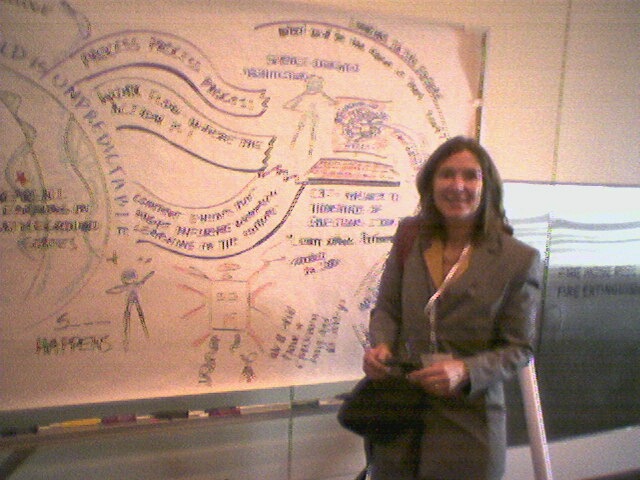
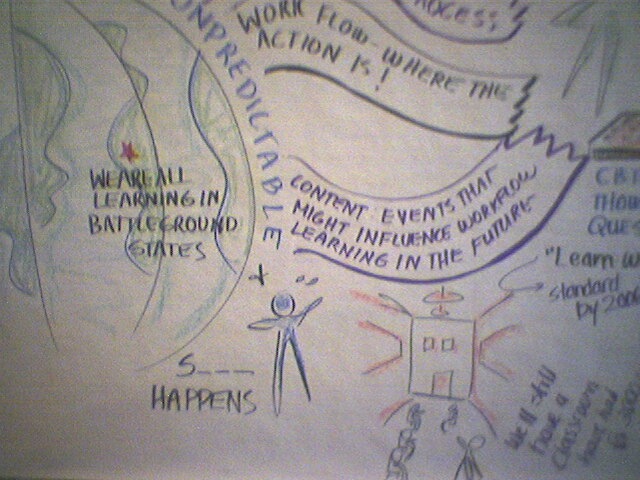
This was a visual representation of the first session by Eileen. Very cool.

0
comments
tags:
Training2004
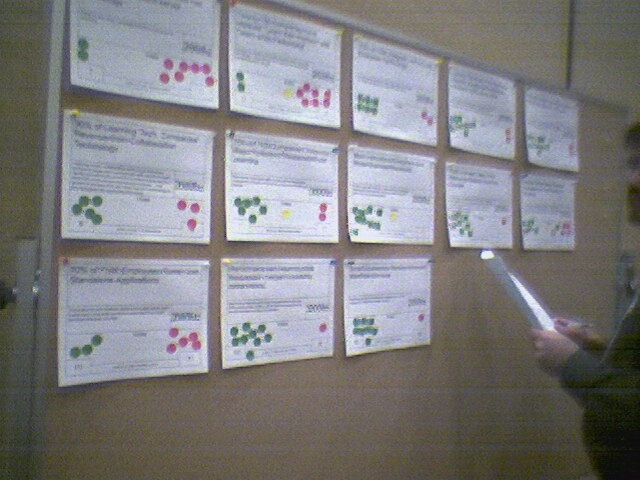
These were the dots from the small groups. Green agreed, red disagreed.
Subscribe to:
Posts (Atom)